Tuesday, May 7, 2013

"Doing international business?" / SMIO presentation at Mjärdevi Science Park

At Linköping University (LiU), the SMIO master program being followed by 95% of international students represents the diversity of the world cultures. Our differences can be interesting and we learn everyday how to build stronger relationships. 
"We didn't all come over on the same ship, but we're all in the same boat."  — Bernard M. Baruch.
Last Friday (May 3rd), Shideh, Andy and Sunny gave a breakfast presentation on the hidden aspects of cross-cultural communication between Sweden and Canada (Shideh), the U.S. (Andy) and China (Sunny). It took place in the Mjärdevi Science Park (nearby the campus) in front of 70 participants: mostly entrepreneurs or experienced businessmen or women engaged in international business, as well as supporting classmates interested in their multicultural experience.

Shideh Tabe, Andrew Wind and Yangzi Sunny Wangsun 

Hofstede's cultural dimensions comparison
between Sweden and Canada
Originally from Iran, Shideh kicked-off the presentation based on her 11 years of experience in the banking sector in Canada: this large country where people hate to be mistaken for Americans! She emphasized that the Canadian culture largely influences their communications in terms of tone of voice, body language, personal space, greetings and most importantly: small talks! Taking into consideration Hofstede's cultural dimensions, she noted that the main differences reside in the masculinity (MAS) and uncertainty avoidance (UAI) of Canada. However, when she arrived in Sweden, she noticed that Canadians focus more on attracting new customers, their satisfaction & loyalty and they give sugar-coat negative answers.

Shideh's key take-aways to do business in Canada were: 
  1. Motivation is in individual success
  2. Incentives to stand out
  3. Customer  is always right
  4. Be ready to have 'small talk' in streets, banks, stores, bus stops, etc.


Hofstede's cultural dimensions comparison
between Sweden and China
Sunny—most Chinese have an English name, she says—started her speech using Hofstede's power distance (PDI) dimension to show that hierarchy is really important in China: employees do not publicly challenge their manager's directives, which makes it easier for the latter to implement changes. Making business in China mainly means building a relationship. Karaoke is an option, a dinner  invitation seems easier but Sunny warned the audience on the Chinese dinner etiquette: "Prepare to get drunk and don't finish all the dishes, otherwise more food will be ordered!" 
Moreover, Chinese dislike being negative: they never say no, but 'maybe' and have difficulties to give negative feedback.


Hofstede's cultural dimensions comparison
between Sweden and the U.S.
Sweden likes the American culture. Yet, Andy started his part on communication in the U.S. by reminding that most of Americans never traveled out of their country. Thus, having a business relationship with a Swede is seen as exotic and highly valued in their culture. Showing Hofstede's individual (IDV) dimension of the U.S. and  Jack Welch's quote "Control your own destiny or someone else will."; Andy shows the dynamic and competitive environment of the American business culture and the motivation of the American workers. As a result, managers focus on the short-term implications of decisions and that's why Andy recommends the audience to focus on 'quick wins' when making business in the U.S.
Moreover, Americans love debates and they'll show it by talking clearly about their issues. Yet, at work, the manager decides: as Steve Jobs said "My job is to say when something sucks rather than sugarcoat it." Andy added that small talks are also common for Americans, it is part of the language protocol. You should answer politely but it doesn't mean that a long-term relationship is being set-up! Eventually, with Hollywood or Broadway, Americans are historically embedded in storytelling. Using metaphors to illustrate a concept and making a scenario to connect them all is the key to understanding in the U.S.

Andy's key take-aways to do business in the U.S. were:
  1. Americans value straight talking and 'getting to the point'
  2. Sell your pluses
  3. Humor or ‘small talk’ can be an important relationship builder
  4. Create storylines.
Doing international business?
The audience enjoyed a buffet-breakfast while Andy wisely concluded a successful presentation, showing the SMIO programme engagement towards the business world and its main actors:
"As our world flattens and we come closer together we find new connections and also expose new individualities. You are the mapmakers of the 21st century, your intercultural business partnerships will expose new ideas and ways of communicating yet to be uncovered that will bring us all forward in the future to come."  Andy.


Sunday, April 14, 2013

Master Thesis (3)

I know, I know: time flies. It's been a month since my last thesis update and again, a lot has changed. For better or worse? I believe that it will turn out better!

Free time? Playing around with the SMIO program's logo...

Initially, we intended to study the automotive industry. More precisely, they hybrid bus: it is a really complex and innovative product, targeting a niche market and making use of very new technologies...it sounded like the perfect product to focus on regarding our project: 

KNOWLEDGE INTEGRATION IN TIMES OF UNCERTAINTY


After promising contacts in Germany, we had to give up our intentions. Indeed, we have a deadline by the end of April, so we had to collect data as early as possible...and this organization was taking its time and it did not seem like we were going to interview them before 2014!

Right...
As a matter of fact, we are now most likely to use secondary data (a raw transcript of a meeting) from another industry: electrical powerplants. More specifically, an organization is developing a new steam turbine. So we stay into complicated engineering stuff :) Obviously, our chapter I (intro) and chapter II (methodology) had to be changed for the most of it...and we go on with chapter IV (empirics) and chapter V (analysis)! Quite challenging!

Since a few weeks, we know the official deadlines
- to hand-in the final version of the thesis: May 27th;
- the seminars will take place for 3 days from: June 3rd;
- the Farewell Ceremony (graduation day) will be on: June 12th.

...and then I'll sleep for a month!

More seriously, I look forward another break into our schedule (8.00 - 17.30 daily). Easter was too short! Hopefully, I have some friends coming soon and then my parents will come for a week in june before mid-summer. I guess it will be weird to not 'have to work' after these intense weeks...I gotta find something else to do by then!

Friday, April 5, 2013

LKPG HA HA! @ Arenabolaget

Backstage
“I love people who make me laugh. I honestly think it's the thing I like most, to laugh. It cures a multitude of ills. It's probably the most important thing in a person.” ― Audrey Hepburn
Laugh brings happiness and relieves stress. That's what LKPG HA HA! intends to do. Linköping's comedy club, created in 2008, introduces comedians on the Backstage of the Konsert och Kongress. Three Thursday nights in Fall (with Messiah Hallberg, Soran Ismail and Ann Westin in 2012) and three Thursday nights in Spring. With some friends, we went to the show last night  (April 4th), which was partly in English, with Al Pitcher from New Zealand.

Al Pitcher

This Kiwi revolutionized the comedy scene in Sweden since he moved here a few years ago. His life as a foreigner led him to joke about all surprising Swedish customs, such as the fika, fy fan, "tackar tackar", etc. Have a look for yourself.

His Fika Tour all over Sweden was a great success. Yesterday, felt like the show I saw was unique: very spontaneous and playing around with the audience a lot.
“Heckle is the funniest thing ever. I was talking about this before the show tonight, that it’s important to have that moment, that one-off event, that feeling that this is only happening tonight,” he explains
The atmosphere was really chill-ax, nice music during the break and people having drinks at the bar... Good times!


Pontus Ströbaek
James McKay, Adeel Faqih,
Pontus Ströbaek & Ben Kearsley
Prior to his show, Ben Kearsley, the usual LKPG HA HA!'s host, invited other comedians on stage. Adeel Faqih, Swedish with Indian origins, made fun of his own day-to-day life in Sweden. He made fun of the "chai tea", explaining that it literrally means tea-tea as chai is the word for tea in many countries... Even though it was in Swedish, I could understand most of it! Then, James McKay, an Englishman, came on stage for a short while, joked about his life in Stockholm and wondered why there was always a picture of the farmer on egg boxes in Sweden. Eventually, Pontus Ströbaek, another Swede, came on stage and... got naked! He said that people laugh when they're surprised. He might have ended chocking a few of them though!

Al Pitcher
As part of his new tour, Påtår (meaning a coffee refill), Al Pitcher was warmly welcome on stage by the audience. Of course, he told jokes about the culture clash he lives everyday in Sweden. He also made fun of Swedish hockey; Ryanair; his two-years old son about whom he sometimes feels like  he's a hobbit on crack; and the two Australian girls in the front row. Using the audience to such extent proves how last night was unique. He ended his hour-long show by desperately inviting people to be friends with him on Facebook! Lots of laugh which put a smile on our faces for the next hours :)

The next show of LKPG HA HA! is on May 2nd, with Jesper Rönndahl. Winner of the Stand-up Championships of Norra Brunn in 2007, he his famous in Sweden for being in the Comedy Fight Club in 2009 and presenting Extra Extra since 2012 on SVT (tv) and on the radio. Some of his sketches can be seen in funny videos on Youtube. There will be other comedians (Henrik Blomqvist, Christina Nordhager and Thomas Eriksson) which Ben Kearsley will introduce before the big show. Check him out!

Monday, March 25, 2013

The Swedish job market

The other day, I went to Arbetsförmedlingen (national job agency) with other students to gather some information about jobs in Sweden. Even though I am currently writing my Master Thesis, I am also looking for Swedish job opportunities. Let's see what people in my situations face today...

Sweden at a glance:
  • Unemployment rate: 8.9% (18.4% among people under 25)
  • In needs for: doctors, engineers, IT developers, etc.
  • Too much: administration workers, cleaning people, receptionists, etc.
  • Working 40h / week
  • 25 vacation days / year (allowed to take 4 weeks in the summer)
  •  No national minimum wage but average (2012):
    • ♂ 30600 SEK / month
    • ♀ 26200 SEK / month
  • Municipal taxes                    ≈ 31%
    • 372100 SEK / year          +20%
    • 532700 SEK / year          +25%
  • Typical workplace: flat organizations, team-working, initiatives-driven, informal, gender equality and strong trade unions.

On top of that, one better speaks Swedish as English-speaking jobs are quite rare. Then, actually getting in a company takes some time, sending a CV and a cover letter is just the beginning of a long process. Most of the time, the firm follows-up with a phone/skype interview, (online) cognitive tests, a group-interview, asking to solve a case study, speed-dating interviews with executives, a trial period and so on. In short: finding a job is extremely time consuming and requires a full investment of oneself (in terms of energy and showing off motivation).


Basically, Swedes look for jobs on different other websites such as thelocal.se/jobs, xpats.nu, iagora.com, onlinenewspaper.com/sweden, lokus.se, eures.europa.eu, etc. (you're welcome!) Of course, foreigners also apply for Swedish jobs when they feel like they meet the requirements. Even though they speak the language already, some of them feel discriminated, simply because of their name which does not sound Swedish. This is a national growing trend, yet forbidden by the law.

See for yourself:
- CV name-change leaves foreign student reeling (The Local) 
Bearers of foreign names less likely to find work in Sweden (Zuzeeko's Blog)
- What’s in a name? A field experiment test for the existence of ethnic discrimination in the hiring process (The Stockholm University Linnaeus Center for Integration Studies)
Ethnic discrimination in Swedish labour market (European Working Conditions Observatory)

[edit April 5th]Swedish study confirms foreign name CV bias (The Local)

Sunday, March 17, 2013

Master Thesis (2)

I thought it was about time to give an update on thesis work. Hopefully, 6 weeks later, we made a bunch of changes. Indeed, we invested a lot of time and energy in the reading-thinking-writing process. Intense days followed each other. Damn, mid-March already! Time flies.

Basically, I like working on the thesis. It feels like we're achieving something. When we printed a draft of our first chapters, it was satisfied to hold the light 20-pages document with MASTER THESIS on the cover. In a way, I'm looking forward to be done :) 

Work in progress.
Whatever we read, books, articles, dissertations or thesis; it somehow influences us in our further work. We build upon existing concepts. Although, we shouldn't forget that it is just a master thesis: no need to establish a new theory, concept or model and compete to be the 21st century's Einstein! Yet, it's more motivating to pursue something that hasn't been established already. Taken from another perspective, what we're doing now should be useful for future research or inspire other students. However, that won't be possible if our work is confidential and forbidden to be published by a firm. Indeed, that's one of our current problem.

Contribution-wise, we intend to add-up to the concept of Knowledge Integration in uncertain environments. Innovative firms developing new complex products have to deal with new technologies which are not even existing yet or not ready to commercialize and their potential customers have specific requirements due to the niche market which is targeted. Hence, we will study how knowledge is integrated from different individuals working together in a team in this context of uncertainty.

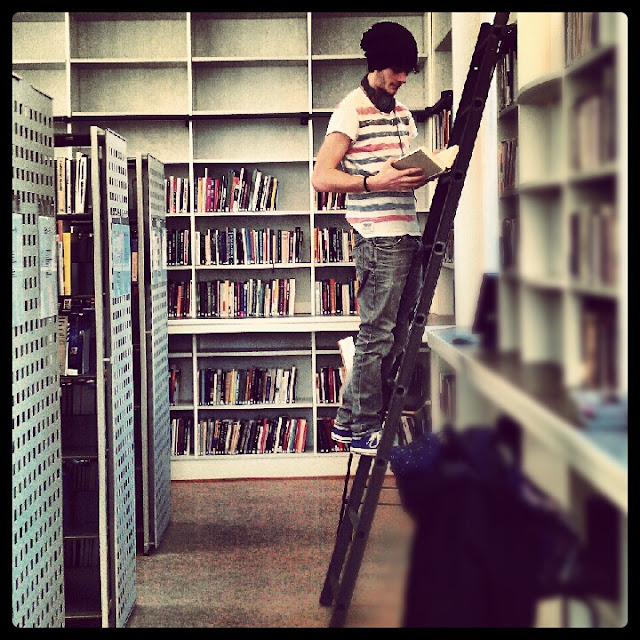
Library worm.
We have been reading a lot of materials. For me it's quite frustrating, because when it comes to writing down my thoughts, I want to talk about everything I learned. The difficulty is to be precise when we use established concepts, without forgetting opposite perspectives. In the pursuit of the perfect text, we spend a considerable amount of time playing around with words and rewriting complete paragraphs every second day!

On the bottom line, it is kinda the same with the methodology chapter. What you intended to do is different from what you're doing or what you'll be able to do! As a result, it is rather challenging to get it done... Anyway, I'm confident. All this hard work gotta pay off at some point :)