A lot happened during the last 2-3 weeks. Long story short: I graduated, I visited Stockholm and its archipelago and I celebrated Midsummer. That's how this long article is divided :)
Showing posts with label SMIO. Show all posts
Showing posts with label SMIO. Show all posts
Tuesday, June 25, 2013
Tuesday, June 4, 2013
Master Thesis (6)
Thesis Defense
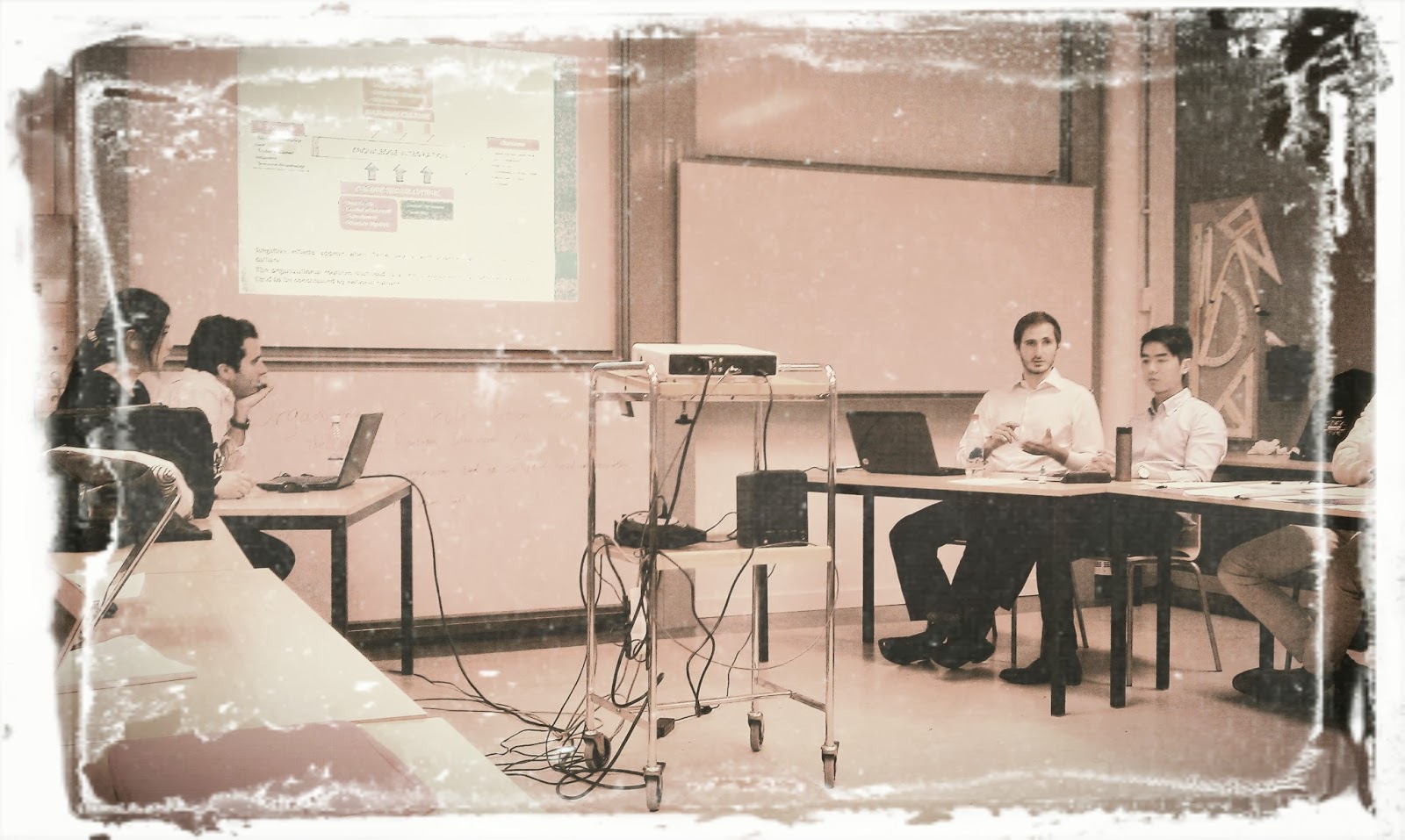
A usual thesis is 70 to 100 page-long, which gives enough room for questions and comments from the opponents to the authors.

The final seminar was structured as the following:
- The authors have 2 min. to point out critical mistakes they have discovered after printing the thesis (as forgetting a 'not' in a sentence which completely changes the message).
- The opponents hold a 10 min. presentation of the authors' thesis. As the audience is supposed to have read the thesis as well, it is basically a concise summary to show how it has been understood. It is customary to ask the authors if the presentation did their work justice or if they would like to add something (approx. 2 min.).
- Then, the discussion/defense begins and lasts 45 min. The discussants lead the seminar, ask questions (big and important issues, first; small details come if there is time left), initiate discussions, point-out strengths and weaknesses in the thesis, and invite comments from the audience. The authors should answer the questions, explain their reasoning, and show extensive understanding. The discussants normally end their section by giving some sort of judgment of the qualities of the author's thesis.
- The advisor and co-examiner have the word for 15 min. to give an overall judgment of the thesis as well as the defense and they can ask some final questions if needed.
- The opponents give to the authors a 5 pages-long hand-out with all their comments and questions. Additionally, the opponents can also provide the authors with the annotated manuscript if desired.
- Once all the defenses are held (over two and a half days), all advisors will convene and discuss the quality of the theses and decide upon the final grades.

This 1h15 final seminar is the place to shine for the authors. It is a final test of explanation. Discussions can even go beyond the thesis' borders. Although some of the groups exchanged their questions beforehand, including the audience in the discussion bring criticism and make the discussions more alive.
I personally enjoyed defending my thesis. Mario and I had the chance to show our understanding of the concepts we used, the reasons behind it and to open-up for further research as well as implications for the existing theories. We received really good feedback from the supervisor Marie Bengtsson and co-examiner Jonas Söderlund, thus we are expecting a decent grade reflecting their opinions :)
.gif)

.gif)
IT'S OVER.
Overall, this Master Thesis was a good experience. Quite stressful when nothing work out as planned, of course, but it helped us to understand the situation that expert engineers encounter in their daily project work! I very much enjoyed the process of research and discovery. I learned a lot during these four months, included myself. I am also very grateful to Mario, he is a dedicated hard worker with the ability to combine different abstract concepts and think them through. It was definitely a good partnership and I sincerely hope that we have more opportunities to work together in the future.
Sunday, June 2, 2013
Master Thesis (5)
Week end? What's that!?
.jpg)

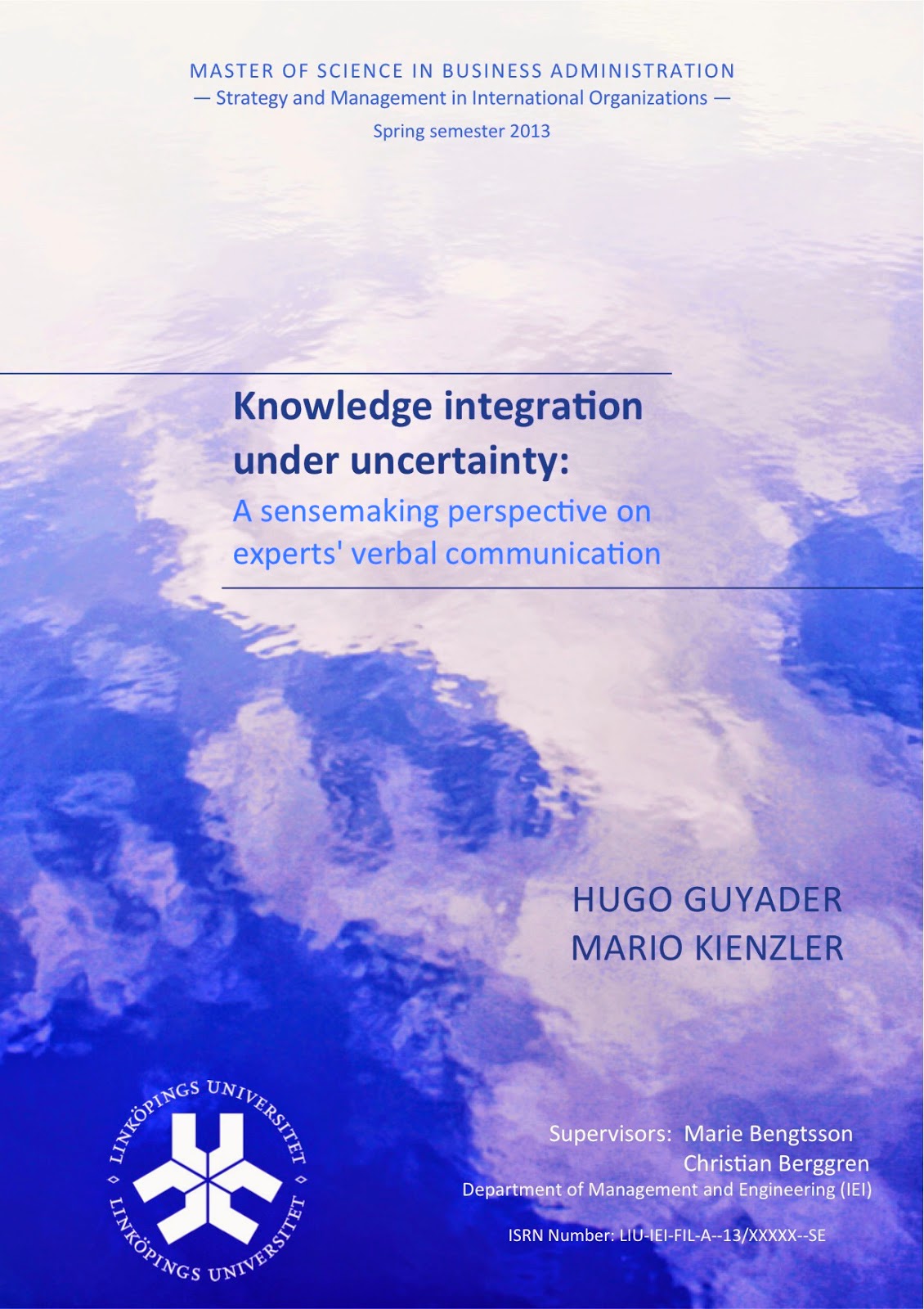
The last 3 weeks have been insane. Every damn day was spent in a library room (think: cold and without window) to significantly boost our thesis from the feedback received during the Pre-Final seminar. Now, we submitted our final version a few days ago and we are satisfied with it! You cannot imagine the mix feelings of proudness and relieve when we eventually have the printed version in hands.
.jpg)
Giving birth after 4 months of hard labor, it's called: Knowledge Integration under Uncertainty.
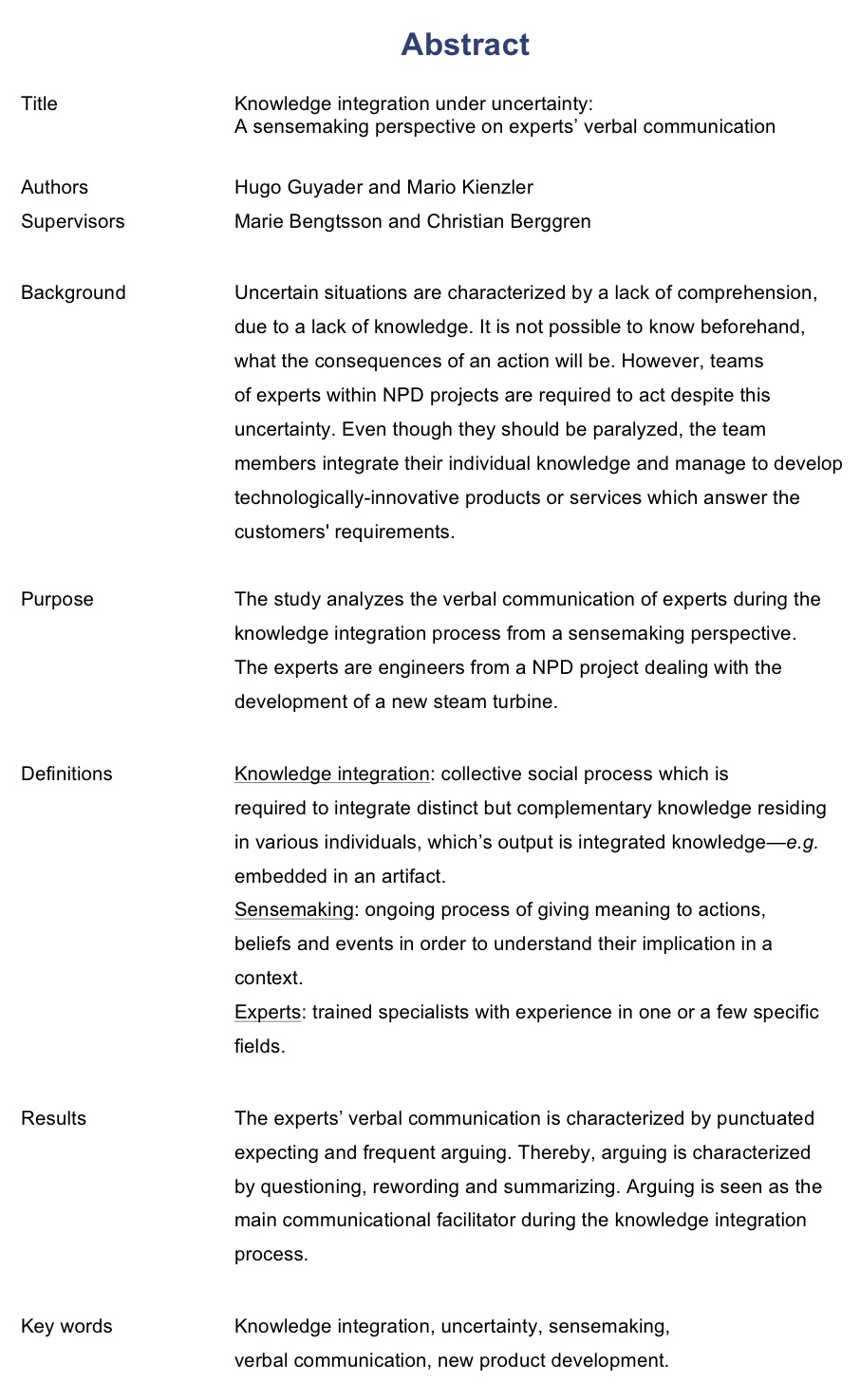
Our study takes a sensemaking perspective on how do expert engineers communicate within a New Product Development (NPD) project team when they integrate their individual knowledge and overcome the environmental uncertainty—which should paralyze the team instead.
Through the belief-driven process of Karl Weick's sensemaking concept, we analyze the verbal communication during a meeting of experts from a NPD project aiming to design a new steam turbine.
The meeting's structure was the following: informing each other, discussing and planning. Taking a deeper look at how do the experts discuss, we identify punctuated forms of expectations and frequent arguments.
Eventually, arguing itself is characterized by elements of questioning, rewording and summarizing. Hence, we see arguing as a facilitator of knowledge integration under uncertainty.
What's next?
The next step is the thesis defense, publicly taking place on June 3rd-5th at Linköping University (1h15 for each thesis). Next to their own defense, each pair of authors is required to make an opposition on one other thesis and actively participate in four other thesis defenses.
Afterwards (and only then), we all will be able to enjoy the great spring weather in Linköping!
Saturday, May 11, 2013
Master Thesis (4)
As I said previously, the previous weeks have been really dedicated to the master thesis. For a 'Pre-Final seminar', our supervisor, Marie Bengtsson, asked to provide her with a complete version of our thesis by April 30th. To describe what she expects, she uses the metaphor of a Swiss cheese: our thesis can have holes and parts missing but it has a form and be held together.
Indeed, we managed to write the missing parts, namely the analysis and the conclusion, before the deadline. Although it was a bit sloppy and we knew it was not perfect, we felt pretty good once we uploaded our thesis draft. This version was supposed to serve as the basis for a first evaluation regarding whether we would be able to present our final master thesis in June. If we are too far behind or the quality is not sufficient, we would have to present in August.
Hopefully, Mario and I managed to hand in a complete thesis, even if it was of a lower quality. Indeed, most of the other groups did not manage to finish in time and are wondering if they'd ever manage to finish before May 27th, the final deadline!
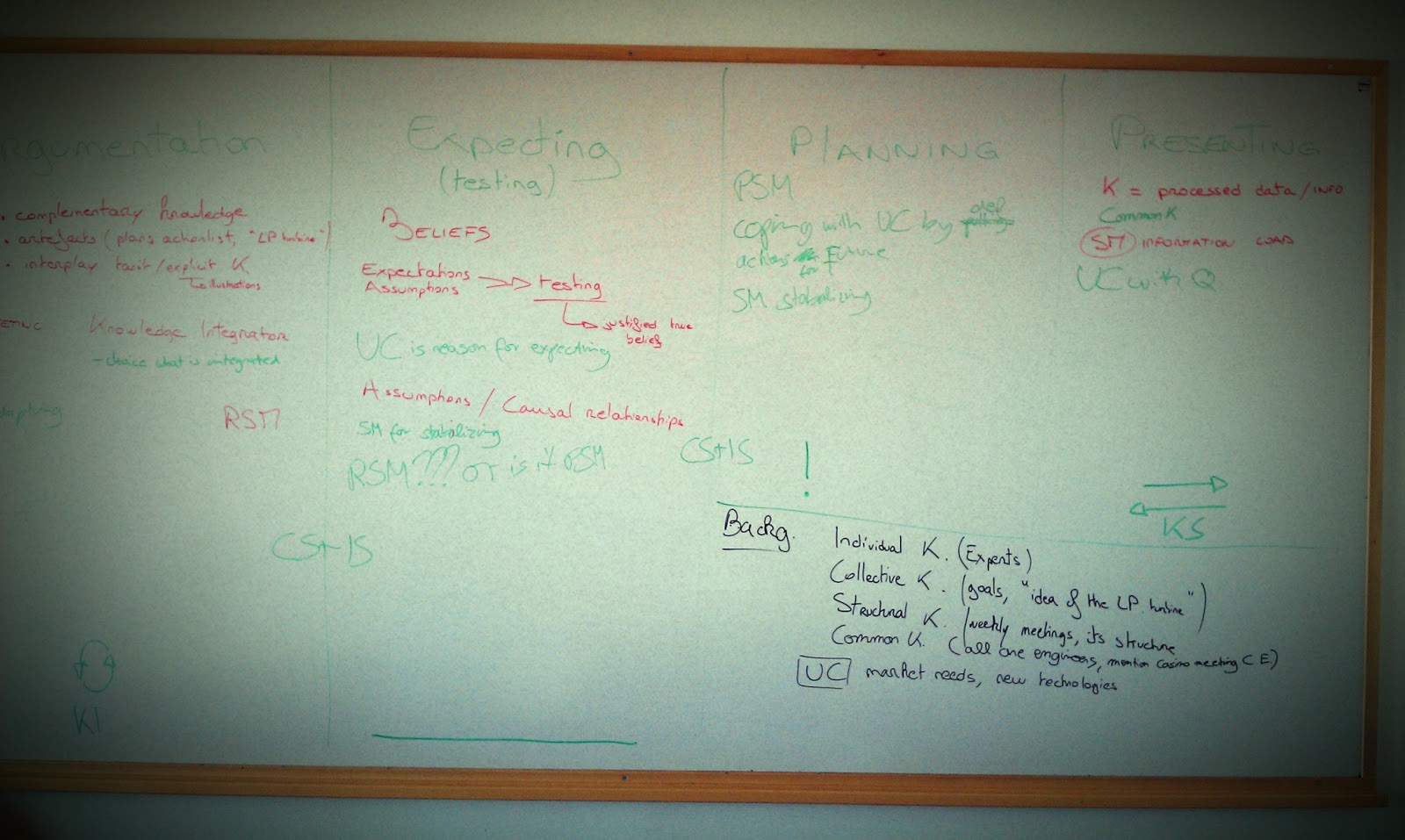
The 'Pie-throwing' seminar was held a few days later, leaving time for each group to read at least 2 theses and give a detailed feedback on one of them. That's how I could combine working / hosting friends for a few days, playing with Swedish red days (Valborg/King's Birthday and Första Maj) and the week-ends.
Anyway, Mario and I really appreciated the comments from our colleagues. It gave us guidelines to go forward and make our draft better! However, since the seminar, we feel really frustrated as we basically spent half a week trying to go deeper in our analysis. The preliminary step was to reformulate our research question, which made us reconsider various theories and rewrite our methodology and empirical chapters. In short, we lost confidence in our work for a moment.
Anyway, Mario and I really appreciated the comments from our colleagues. It gave us guidelines to go forward and make our draft better! However, since the seminar, we feel really frustrated as we basically spent half a week trying to go deeper in our analysis. The preliminary step was to reformulate our research question, which made us reconsider various theories and rewrite our methodology and empirical chapters. In short, we lost confidence in our work for a moment.
Receiving feedback is helpful and devastating. Of course, there is no point in receiving only positive feedback as we have 3 weeks left before the final hand-in. Yet, there are some comments that we would have preferred to receive earlier as we could have tackled our issues directly!

In other words, we are going through a really stressful period. I find it really hard to lock ourselves in study rooms on a 8.00-18.00 shift everyday, when the sun is shining hard outside and the thermometer exceeds the 20°C!!! But I rather remind myself: why give-up now? After 4 months, there are only 3 weeks left :)
Tuesday, May 7, 2013
"Doing international business?" / SMIO presentation at Mjärdevi Science Park
At Linköping University (LiU), the SMIO master program being followed by 95% of international students represents the diversity of the world cultures. Our differences can be interesting and we learn everyday how to build stronger relationships.
"We didn't all come over on the same ship, but we're all in the same boat." — Bernard M. Baruch.
Last Friday (May 3rd), Shideh, Andy and Sunny gave a breakfast presentation on the hidden aspects of cross-cultural communication between Sweden and Canada (Shideh), the U.S. (Andy) and China (Sunny). It took place in the Mjärdevi Science Park (nearby the campus) in front of 70 participants: mostly entrepreneurs or experienced businessmen or women engaged in international business, as well as supporting classmates interested in their multicultural experience.
 |
| Shideh Tabe, Andrew Wind and Yangzi Sunny Wangsun |
 |
| Hofstede's cultural dimensions comparison between Sweden and Canada |
Originally from Iran, Shideh kicked-off the presentation based on her 11 years of experience in the banking sector in Canada: this large country where people hate to be mistaken for Americans! She emphasized that the Canadian culture largely influences their communications in terms of tone of voice, body language, personal space, greetings and most importantly: small talks! Taking into consideration Hofstede's cultural dimensions, she noted that the main differences reside in the masculinity (MAS) and uncertainty avoidance (UAI) of Canada. However, when she arrived in Sweden, she noticed that Canadians focus more on attracting new customers, their satisfaction & loyalty and they give sugar-coat negative answers.
Shideh's key take-aways to do business in Canada were:
- Motivation is in individual success
- Incentives to stand out
- Customer is always right
- Be ready to have 'small talk' in streets, banks, stores, bus stops, etc.
 |
| Hofstede's cultural dimensions comparison between Sweden and China |
Sunny—most Chinese have an English name, she says—started her speech using Hofstede's power distance (PDI) dimension to show that hierarchy is really important in China: employees do not publicly challenge their manager's directives, which makes it easier for the latter to implement changes. Making business in China mainly means building a relationship. Karaoke is an option, a dinner invitation seems easier but Sunny warned the audience on the Chinese dinner etiquette: "Prepare to get drunk and don't finish all the dishes, otherwise more food will be ordered!"
Moreover, Chinese dislike being negative: they never say no, but 'maybe' and have difficulties to give negative feedback.
 |
| Hofstede's cultural dimensions comparison between Sweden and the U.S. |
Sweden likes the American culture. Yet, Andy started his part on communication in the U.S. by reminding that most of Americans never traveled out of their country. Thus, having a business relationship with a Swede is seen as exotic and highly valued in their culture. Showing Hofstede's individual (IDV) dimension of the U.S. and Jack Welch's quote "Control your own destiny or someone else will."; Andy shows the dynamic and competitive environment of the American business culture and the motivation of the American workers. As a result, managers focus on the short-term implications of decisions and that's why Andy recommends the audience to focus on 'quick wins' when making business in the U.S.
Moreover, Americans love debates and they'll show it by talking clearly about their issues. Yet, at work, the manager decides: as Steve Jobs said "My job is to say when something sucks rather than sugarcoat it." Andy added that small talks are also common for Americans, it is part of the language protocol. You should answer politely but it doesn't mean that a long-term relationship is being set-up! Eventually, with Hollywood or Broadway, Americans are historically embedded in storytelling. Using metaphors to illustrate a concept and making a scenario to connect them all is the key to understanding in the U.S.
Andy's key take-aways to do business in the U.S. were:
- Americans value straight talking and 'getting to the point'
- Sell your pluses
- Humor or ‘small talk’ can be an important relationship builder
- Create storylines.
 |
| Doing international business? |
The audience enjoyed a buffet-breakfast while Andy wisely concluded a successful presentation, showing the SMIO programme engagement towards the business world and its main actors:
"As our world flattens and we come closer together we find new connections and also expose new individualities. You are the mapmakers of the 21st century, your intercultural business partnerships will expose new ideas and ways of communicating yet to be uncovered that will bring us all forward in the future to come." — Andy.

Sunday, April 14, 2013
Master Thesis (3)
I know, I know: time flies. It's been a month since my last thesis update and again, a lot has changed. For better or worse? I believe that it will turn out better!
 |
| Free time? Playing around with the SMIO program's logo... |
Initially, we intended to study the automotive industry. More precisely, they hybrid bus: it is a really complex and innovative product, targeting a niche market and making use of very new technologies...it sounded like the perfect product to focus on regarding our project:
KNOWLEDGE INTEGRATION IN TIMES OF UNCERTAINTY
After promising contacts in Germany, we had to give up our intentions. Indeed, we have a deadline by the end of April, so we had to collect data as early as possible...and this organization was taking its time and it did not seem like we were going to interview them before 2014!
 |
| Right... |
As a matter of fact, we are now most likely to use secondary data (a raw transcript of a meeting) from another industry: electrical powerplants. More specifically, an organization is developing a new steam turbine. So we stay into complicated engineering stuff :) Obviously, our chapter I (intro) and chapter II (methodology) had to be changed for the most of it...and we go on with chapter IV (empirics) and chapter V (analysis)! Quite challenging!
Since a few weeks, we know the official deadlines
- to hand-in the final version of the thesis: May 27th;
- the seminars will take place for 3 days from: June 3rd;
- the Farewell Ceremony (graduation day) will be on: June 12th.
...and then I'll sleep for a month!
More seriously, I look forward another break into our schedule (8.00 - 17.30 daily). Easter was too short! Hopefully, I have some friends coming soon and then my parents will come for a week in june before mid-summer. I guess it will be weird to not 'have to work' after these intense weeks...I gotta find something else to do by then!
Sunday, March 17, 2013
Master Thesis (2)
I thought it was about time to give an update on thesis work. Hopefully, 6 weeks later, we made a bunch of changes. Indeed, we invested a lot of time and energy in the reading-thinking-writing process. Intense days followed each other. Damn, mid-March already! Time flies.
Basically, I like working on the thesis. It feels like we're achieving something. When we printed a draft of our first chapters, it was satisfied to hold the light 20-pages document with MASTER THESIS on the cover. In a way, I'm looking forward to be done :)
 |
| Work in progress. |
Whatever we read, books, articles, dissertations or thesis; it somehow influences us in our further work. We build upon existing concepts. Although, we shouldn't forget that it is just a master thesis: no need to establish a new theory, concept or model and compete to be the 21st century's Einstein! Yet, it's more motivating to pursue something that hasn't been established already. Taken from another perspective, what we're doing now should be useful for future research or inspire other students. However, that won't be possible if our work is confidential and forbidden to be published by a firm. Indeed, that's one of our current problem.
Contribution-wise, we intend to add-up to the concept of Knowledge Integration in uncertain environments. Innovative firms developing new complex products have to deal with new technologies which are not even existing yet or not ready to commercialize and their potential customers have specific requirements due to the niche market which is targeted. Hence, we will study how knowledge is integrated from different individuals working together in a team in this context of uncertainty.
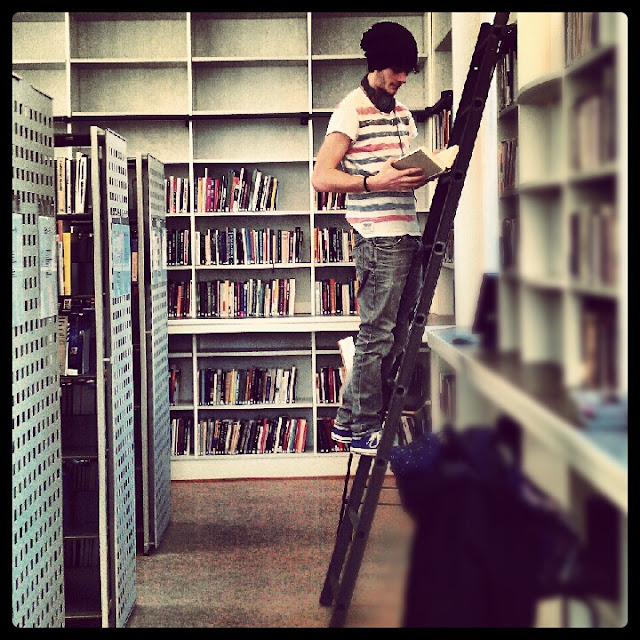 |
| Library worm. |
We have been reading a lot of materials. For me it's quite frustrating, because when it comes to writing down my thoughts, I want to talk about everything I learned. The difficulty is to be precise when we use established concepts, without forgetting opposite perspectives. In the pursuit of the perfect text, we spend a considerable amount of time playing around with words and rewriting complete paragraphs every second day!
On the bottom line, it is kinda the same with the methodology chapter. What you intended to do is different from what you're doing or what you'll be able to do! As a result, it is rather challenging to get it done... Anyway, I'm confident. All this hard work gotta pay off at some point :)
Monday, February 4, 2013
Master Thesis (1)
Still unpacking the car, the master thesis reality caught me back. It's about time to speed up!
My thesis partner is Mario K., my German study mate since the beginning of the program. We know well each other, as well as our thesis supervisor, Marie Bengtsson, as she taught us Leadership & Organization and Strategic Human Resource Management. Precisely, we intend to study knowledge integration in innovative firms from the city bus industry, developing diesel-electric hybrid powertrain solutions.

Today, we had a poster presentation with all SMIO generations. The 19 thesis groups of SMIO'12 presenting their projects (the more detailed and extended presentation, the more feedback/recommendations received to improve) and the SMIO'13 poped by to ask us questions, as we did last year with the SMIO'11.
It was nice to finally see what everybody has been working on over the last month, and how far it actually got them. Mario and me received constructive feedback that'll help us narrow down our project from the two possible topics we had in mind:

- "Knowledge integration in the light of the exploration/exploitation dilemma in innovative firms".
- "Knowledge integration to build sustained competitive advantage in innovative firms".
We aim to design a case study with triangulation methods: semi-structured interviews with managers and engineers from an innovative organization, a semi-structured interview with an industry expert and secondary-data analysis of corporate materials and press releases from inside/outside the organization.
That's it for now!
Wednesday, January 30, 2013
ERASMUS - the bitter end
 |
| Atomium, Brussels. |
BLOCUS
The Belgian exam period, so-called blocus, is now over (at least for me). It's been difficult to study all my courses together. I felt my head was a big pot where I threw in all different kinda theoretical concepts. The thing is, I ended up with a big mixed soup!

Most of my exams were multiple-choice-questions, based on books, often written by the class professors themselves. Of course, it was highly specific. But they made it even harder! For instance, I was asked to choose the right statement among four propositions and to justify my choice for each statement. Quite confusing!
All in all, it's been a quite stressful period. I'm glad it's over! Obviously, I "enjoy" more the Swedish examination system: one course at a time. The exams themselves are harder (open questions and discussions) but there is less confusion. At least my schedule was clearer! Anyway, my exchange semester as an Erasmus student ended with my last exam.
UGENT
Among the six Belgian universities ranked in the Times Higher Education World University Ranking, I spent my semester at Universiteit Gent (World rank: 93rd).
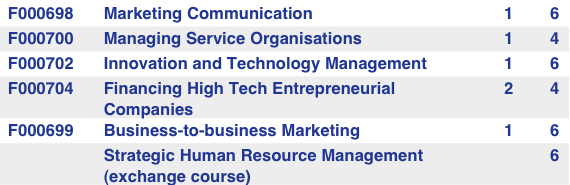 |
| Course code - Course name - ECTS credits |
I was following 6 courses: Marketing Communication, Managing Service Organizations, Innovation & Technology Management, Financing High-Tech Entrepreneurial companies and Business-to-Business Marketing at the UGent and Strategic Human Resource Management at HogeSchool Gent.
If everything goes smoothly, I'll collect 32 ects credits which will be integrated in my master program at Linköping University (thanks to my Learning Agreement). Additionally, I had a Dutch class (4 ects credits) at UCT, but that was just "for fun"!

But all these data don't say much about my proper experience. Overall, I liked my exchange! Even though I've already studied some concepts before, the courses' content was interesting and for some, stimulating. However, I had trouble with Dutch. Meaning, a lack of English translation. Finding information on their online platform (Minerva) or from their emails was rather messy! During an exam, the teacher even gave the instructions in Dutch. No English!
More critics? I found the professors inaccessible (I had two appointments with a teacher who didn't show up! On the third one, he was busy on the phone for 20mn. I gave up.); I missed feedback from them: 3 months after an assignment, still no grades (counting for 40% of the final grade); and I found bizarre that most of them ask the students to buy their own published books (e.g. I'd have to pay 70€ for a book!).
Nevertheless, I had the chance to meet great people outside the classrooms. That's what matters!
MASTER THESIS
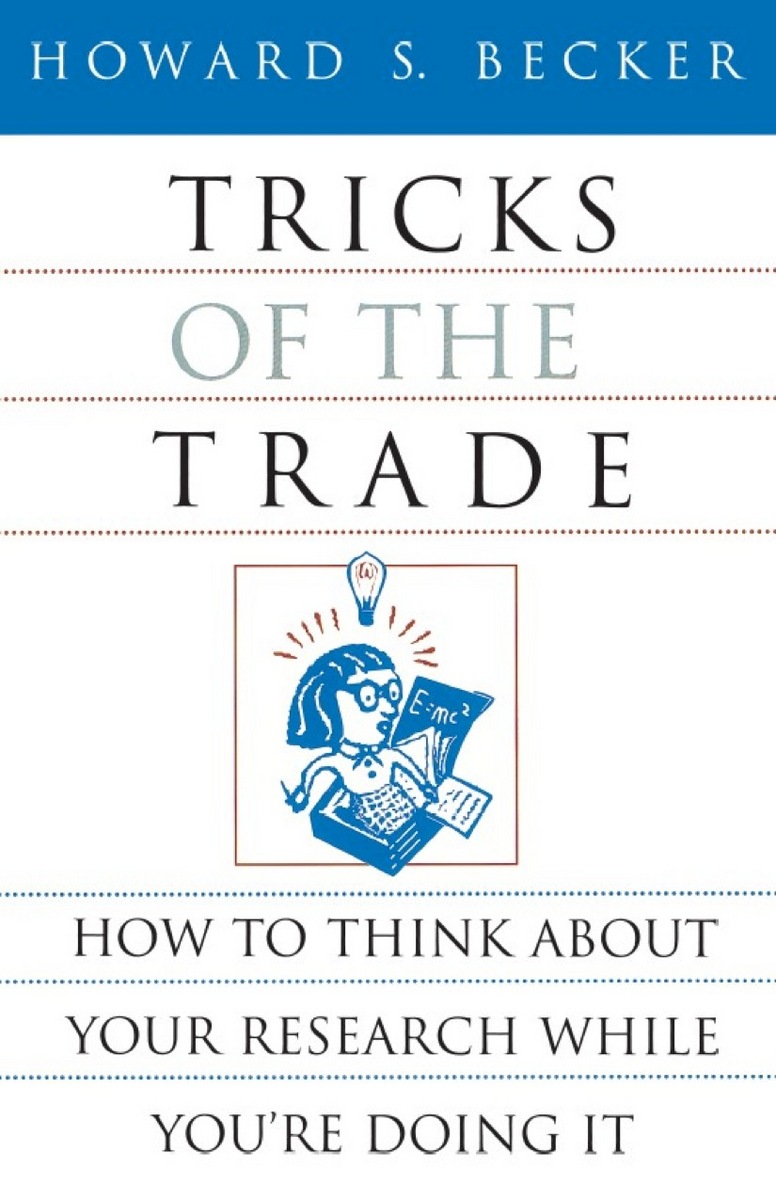
Game on! While I was studying for my exams at UGent, my SMIO classmates at Linköping University were attending the introductory seminars on the Master Thesis, since January 21st. The thesis kick-off is based on a book: Tricks of the Trade - how to think about your research while you're doing it (H.S. Becker, 1998) which gives us lots of examples about what to (not) write and most importantly, through the author's experience in social sciences.
The fourth and last semester of my SMIO program is fully dedicated to the master thesis. In pair of two students, we have to hand in our pre-final version by the end of April, and the final version by the end of May. Each group has a supervisor to provide some guidelines along the process. Our 50-70 pages document will then be evaluated on its problem consideration, structure and logic, theoretical support, frame of reference, research method, empirical data report, analysis, and conclusions. We'll also have to defend our final thesis in public seminars upon the final version.
 |
| Waffle bus, Brussels. |

I'm looking forward being back in Linköping, Sweden. I missed mother Nature, the coziness of the city center and the university facilities. I'll enjoy my final semester at LiU! I'll keep you updated under the thesis writing process ;)
Now, it's time to pack. It's a few hours drive to get to the ferry bringing us back to Sweden...
Tot ziens België!
Tot ziens België!
Friday, October 12, 2012
Video on the SMIO Master Program at Linköping University
A few months ago, a video-crew followed one of my SMIO classmates at Linköping University over a few days to gather footages on every-day activities (class, social gathering and even football game) as a student in this program. In short, that was my daily routine for one year as well:
It's also a very good explanation of all these French words ;)
Monday, September 10, 2012
Sweet transition
Sweden
It's been two weeks since the semester started again, back in Sweden. My classmates welcomed the first year students in Linköping with a bunch of events as barbecues, sightseeing tours, get-together-parties and so on; thanks to Kristina and the rest of her team of SMIO Big Brothers and Sisters (follow their blog here).
Unfortunately, I didn't get back to Sweden and I actually don't plan to within the next 2 months. Instead, when my friends were enjoying the student fair Kallas downtown Linköping, I was visiting friends in Berlin, Paris, Toulouse, Bordeaux and Angers. I decided to take it (really) easy for a few more weeks!
Belgium
As I didn't take part in the summer Dutch course in Ghent University, my Erasmus semester officially starts on September 21th, with two kick-off days. Moreover, I got a student room in a corridor of the university! That was good news as it seems super hard to find an accommodation there. Now that I just bought my bus tickets, I'm all set for my stay in Belgium!
A new experience is soon to begin: one Erasmus semester in Ghent University!
Monday, July 9, 2012
Première année à LiU terminée - 90 Crédit ECTS accumulés !
Le deuxième semestre de mon Master SMIO s'est terminé par le dernier module sur la Gestion des Resources Humaines. Ce qui signifie que nous sommes tous en vacances pour l'été. Certains sont rentrés chez eux, certains sont restés à Linköping, et certains sont partis ailleurs...ce qui fût mon cas en allant faire du Wwoofing au Portugal (expérience très réussie !). Du reste, le troisième semestre recommence fin Août, avec l'arrivée des étudiants en première année, quelques jours avant le début des cours. Mais pas pour moi ! Comme prévu : je vais faire un semestre d'échange Erasmus à Gand, en Belgique.
 Un an à Linköping qui s'achève avec un bilan très positif ! J'ai rencontré des gens très ouverts et cultivés, des collègues de classe très sympas et des colocataires géniaux. J'ai visité quelques nouveaux endroits suédois et aussi fais visiter ma Suède à des amis. Pour couronner le tout, c'est aussi une réussite scolaire avec une tripotée de bonnes et très bonnes notes tout au long de l'année, tout en accumulant 90 crédits ECTS (au lieu de 60 crédits seulement)...
Msc Business Administration - SMIO :
Après avoir pris deux semaines et demi de vacances au Portugal (WWOOF Experience...), je passe mon mois de juillet à travailler de nuit dans un camping. C'est censé me laisser le temps d'organiser les vacances du mois d'Août : direction la côte Ouest des États-Unis en famille !!!
Place aux vacances donc...! Au fait, mes prochaines expériences seront à suivre en Anglais ;)
CHEERS!
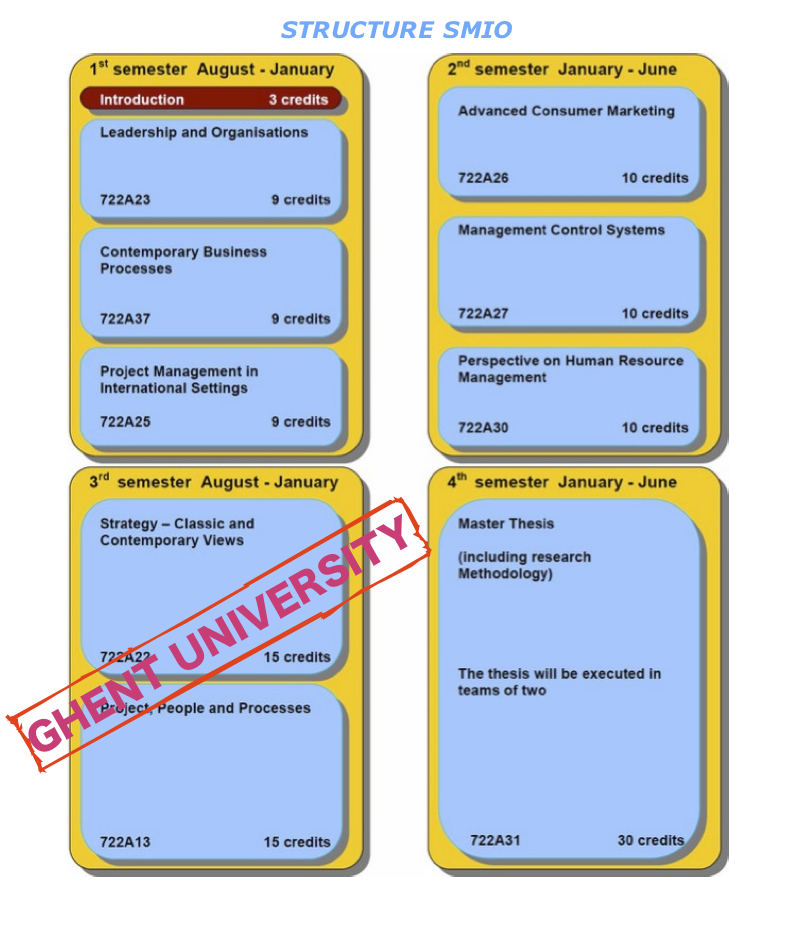
Msc Business Administration - SMIO :
- Introduction to Academic Studies, Advanced level (3 crédits ECTS)
- Leadership & Organisation (9 crédits ECTS) - A (90/100 points)
- Contemporary Business Processes (9 crédits ECTS) - C (74/100 points)
- Project Management in International Settings (9 crédits ECTS) - A (95/100 points)
- Advanced Consumer Marketing (10 crédits ECTS) - A (94/100 points)
- Management Control Systems (10 crédits ECTS) - B (60,1/70 points)
- Perspectives on Human Resource Management (10 crédits ECTS) - B (49/60 points)
- Suédois niveau 2 (7,5 crédits ECTS) - C
- Suédois niveau 3 (7,5 crédits ECTS) - C
- Sustainable Development in the Global Context (15 crédits ECTS) - A
Après avoir pris deux semaines et demi de vacances au Portugal (WWOOF Experience...), je passe mon mois de juillet à travailler de nuit dans un camping. C'est censé me laisser le temps d'organiser les vacances du mois d'Août : direction la côte Ouest des États-Unis en famille !!!
Place aux vacances donc...! Au fait, mes prochaines expériences seront à suivre en Anglais ;)
CHEERS!
Sunday, June 3, 2012
SMIO/ Perspectives on Human Resource Management (3/3)
Après les trois premières semaines où nous avions eu deux modules plutôt différents basés sur la Gestion des Ressources Humaines (GRH) spécifique aux Project-Based Organizations (PBO) et aux organismes à but non-lucratif, nous avons continué sur deux autres modules ainsi qu'un examen final: take-home exam.

GESTION DES RESSOURCES HUMAINES À L'INTERNATIONAL
Le 3ème module fut consacré à la GRH internationale: la mobilité à travers le Globe, dont le professeur était Marie Bengtsson (vraiment apprécié par la classe car elle était déjà notre prof pour notre premier cours : Leadership & Organization). Après une conférence soulignant l'importance de la mondialisation ainsi que ses effets, les enjeux de contrôle et de coordination dans ce contexte spécial, le concept de glocalisation (Think Global, Act Local), les diverses stratégies d'internationalisation depuis les premières entreprises de commerce international et enfin les défis/opportunités concernant la gestion des expatriés. Cette dernière partie sur l'expatriation a soulevé des questions de recherche intéressantes pour aller plus loin sur le sujet...à garder dans un coin de ma tête !
 |
| Livret de références. (Cliquez pour lire) |
D'ailleurs, notre devoir en groupe était de créer un livret (=booklet) de défis et d'opportunités à propos de la GRH internationale. Ce devoir avait deux sous-parties : d'abord, une recherche individuelle massive d'articles scientifiques avec des résultats intéressants. Deuxièmement, mettre sur pied un livret avec toutes les références que nous conseillons à toute entreprise de lire, si elles pensent à s'expatrier.
Le plus drôle était la formation des groupes ! Après la première partie (la collecte d'articles), nous avons eu 3h de speed-dating : nous avions chacun 1mn pour présenter nos conclusions à un autre étudiant, afin de savoir si nos conclusions sont les mêmes (aucun intérêt à faire équipe ensemble) ou différentes (plus de connaissances en s'associant ensemble).
Bon, je n'avais jamais fais de speed-dating auparavant... et je ne pense pas que je le ferais maintenant ! C'était tellement stressant, cette tension à en devenir fou. Et puis, après la 14e fois que je répétais le même discours à une nouvelle personne, il y a de quoi tourner de l'oeil ! Quoi qu'il en soit, un logiciel a ensuite déterminé les groupes de 4 élèves ensemble et 2 jours plus tard, le livret était prêt pour chaque équipe. Comme mon groupe a obtenu 7/7 points, je pense qu'il était assez bon :)
La semaine s'est terminée sur un seminar de 4h basé sur une étude de cas : Le Comité International de la Croix-Rouge, Managing Across Cultures. Toute la classe est venu au séminaire, n'ayant seulement lu l'étude de cas. Puis nous nous sommes séparés en deux groupes qui ont dû préparer une argumentation pour «combattre» les uns contre les autres dans une bataille d'arguments : un 1er groupe argumente pendant 3 min et un 2ème groupe contre-argumente pendant 30sec. Le processus a été répété 8 fois ! Encore une fois, assez stressant, mais vraiment intéressant d'un point de vue d'apprentissage !
GESTION DES RESSOURCES HUMAINES ET TENDANCES SOCIALES
Le 4ème et dernier module, GRH & Tendances Sociales : Responsabilité Sociale des Entreprises (RSE) a été traité par Charles Woolfson et Branka Likic-Brboric. Cela a commencé avec une conférence très longue et ennuyeuse sur la RSE : sa (r)évolution, son contexte, ses acteurs, ses défis, etc. Une perte de temps de 3h puisque nous avions déjà abordé ces sujets pendant certains cours précédents...
 Le lendemain, Charles Woolfson nous a dramatiquement raconté une histoire contemporaine : l'Explosion de Deepwater Horizon. Beaucoup de photos, quelques citations de journaux et surtout un discours animé de haine envers British Petroleum pour nous rappeler tout ce qui s'est passé jusqu'à ces dernières semaines : l'explosion, ses conséquences environnementales, les réactions, le nettoyage et le coût humain.
Tout cela nous amène au travaux de groupe à terminer pour la fin de semaine : défendre l'une des partie prenante au procès fictif entre BP, le gouvernement, les ONGs, les familles des victimes, et les organismes de régulations. Chaque groupe a du préparé à speech de 10mn à présenter face à un groupe opposant. Mon groupe représentait BP, face aux familles des victimes. Charles nous a bien laissé comprendre que quoiqu'il arrive, BP allait perdre le procès. Rien de plus motivant pour nous !
Vendredi, Charles était habillé dans une sorte de robe de chambre qu'il utilisait comme robe de juge. Plutôt marrant quand on y repense... Le procès s'est déroulé comme prévu : chaque partie s'est défendue et a rejetée la faute sur les autres avec 10mn de speech, suivie d'un débat de questions / réponses de 10 autres minutes. Et, BP a perdu. Mais nous avons tous obtenu les points maximum (5/5). Nous étions donc en week-end, censé nous reposé pour être prêt pour l'examen maison de lundi...
TAKE-HOME EXAM
Après 4 différent modules abordant des perspectives différentes sur la GRH, il nous fallait bien sur, passer un examen. Cette fois-ci, une nouveauté : nous avons une semaine pour répondre à 4 questions (une par module), avec libre accès à toute la littérature utilisée précédemment, avec 1500 mots par réponse. Coup d'envoi : lundi 28 mai, 12h00. Pour être sur d'arriver au bout, j'ai commencé par un break d'une demi-journée, normal.
L'examen seul, nous donnera la note finale du cours. Tous les travaux de groupe réalisés pendant les 4 modules ne servent à rien, du moment que l'on a 25/40 points...pas très difficile donc. Du coup il y avait pas mal de pression sur ce dernier devoir ! Le plan était de faire une question par jour. Sauf que mercredi, avec quelques autres collègues de classe, nous avons participé à la Diversity Cup que nous n'avons bien sûr pas remporté. Au final, après une fin de semaine intense, j'ai terminé mon exam 2 jours en avance :)
Voilà, j'ai terminé ma première année à Linköping University. Une réussite sur plusieurs points : éducation, social et culturel. J'ai rencontré des personnes très intéressantes avec qui je veux garder contact. J'ai de la chance de partir un semestre pour mieux revenir...d'autres partent définitivement, maintenant qu'ils sont diplômés. Bref, GREAT SUCCESS!

 |
| Charles Woolfson |
Tout cela nous amène au travaux de groupe à terminer pour la fin de semaine : défendre l'une des partie prenante au procès fictif entre BP, le gouvernement, les ONGs, les familles des victimes, et les organismes de régulations. Chaque groupe a du préparé à speech de 10mn à présenter face à un groupe opposant. Mon groupe représentait BP, face aux familles des victimes. Charles nous a bien laissé comprendre que quoiqu'il arrive, BP allait perdre le procès. Rien de plus motivant pour nous !
Vendredi, Charles était habillé dans une sorte de robe de chambre qu'il utilisait comme robe de juge. Plutôt marrant quand on y repense... Le procès s'est déroulé comme prévu : chaque partie s'est défendue et a rejetée la faute sur les autres avec 10mn de speech, suivie d'un débat de questions / réponses de 10 autres minutes. Et, BP a perdu. Mais nous avons tous obtenu les points maximum (5/5). Nous étions donc en week-end, censé nous reposé pour être prêt pour l'examen maison de lundi...
TAKE-HOME EXAM
Après 4 différent modules abordant des perspectives différentes sur la GRH, il nous fallait bien sur, passer un examen. Cette fois-ci, une nouveauté : nous avons une semaine pour répondre à 4 questions (une par module), avec libre accès à toute la littérature utilisée précédemment, avec 1500 mots par réponse. Coup d'envoi : lundi 28 mai, 12h00. Pour être sur d'arriver au bout, j'ai commencé par un break d'une demi-journée, normal.
 |
| Mercredi c'est foot ! |
 |
| Photo de classe |
Monday, May 14, 2012
SMIO/ Perspectives on Human Resource Management (2/3)
J'en suis rendu à la moitié de mon dernier cours, Perspectives on Human Resource Management, il doit être temps de parler de ces 3 dernières semaines...
La grosse première semaine fut dédié à la littérature : nous étions censés lire plus de 30 articles afin d'être préparé pour les 4 prochains modules et y rentrer directement au coeur du sujet. Le premier module était consacré aux pratiques de Gestion des Ressources Humaines (GRH) dans les Project-Based Organizations (PBO) et c'était dirigé par Karin Bredin. Nous avons commencé par définir en profondeur ce qu'est une PBO et ce qu'on entend par travailler sous forme de projets. Tout cela a eu la gentillesse de de nous rappeler ce que nous avons bossé pendant le cours de gestion de projet dans les organisations internationales. Puis nous nous sommes penché sur les défis de la GRH dans les PBO, ainsi que leurs solutions adéquates. Nous avons étendu cette approche avec un travail en groupe : en tant que consultants RH (4 élèves par groupe), nous avons présenté les défis et les solutions au directeurs d'une fausse organisation (représenté par le reste de la classe) lors d'un seminar. Dans l'ensemble, c'était une semaine intéressante ! J'ai senti ça comme si c'était une semaine de coup d'envoi... Pas trop de pression !
 |
| Extrait de ma présentation sur le développement de compétences |
Le deuxième module était consacré à la GRH dans les organismes à but non-lucratif (Non-Profit Organizations - NPO) et dirigé par Åsa-Karin Engstrand. Pendant la conférence, nous avons eu un aperçu des caractéristiques spécifiques, conduisant à certains défis, comment y répondre et les différentes pratiques de GRH dans les PBOs. Nous avons également continué avec un travail de groupe où nous avons dû concevoir un processus de recrutement pour une NPO que nous avons choisi. Et ce fut amusant à faire ! J'ai bien aimé découvrir les principales différences dans des NPOs, plus spécifiquement en GRH : gestion des bénévoles, salaires moins élevés, motivations intrinsèques, etc.
 |
| Extrait de notre processus de recrutement pour une NPO cherchant à combler un poste de Project Manager. |
Deux modules restent à terminer, un examen maison à rédiger et dans 3 semaines j'ai terminé ma première année !
Tuesday, April 24, 2012
SMIO/ Perspectives on Human Resource Management (1/3)
Le même jour où nous avons terminé le cours de contrôle de gestion sur avec une semaine intense se terminant sur un examen important, nous avons directement commencé notre nouveau cours (et aussi le dernier de l'année 2011-2012) : Perspectives on Human Resources Management. Comme c'était seulement un cours d'introduction, tout fût réglé en 45mn, faisant réapparaître les sourires sur nos visages: le week-end pouvait enfin commencer !
Mais restons concentré sur mon nouveau cours. Bon, d'abord, il s'agit d'un cours avancé sur la Gestion des Ressources Humaines (GRH), ce qui signifie que nous allons passer directement à des thèmes précis qui sont :
- Module 1 : gestion des ressources humaines dans les organisations basé sur un fonctionnement par projet- Module 2 : la GRH dans les organismes à but non lucratif
- Module 3 : GRH International - Mobilité à travers le monde
- Module 4 : les tendances en matière de GRH et de la société - Responsabilité sociale des entreprises
Chaque module durera une semaine. Avant le Module 1, nous avons une « semaine plutôt relax », visant à créer une base de connaissances dans le domaine de la GRH. Cela comprend une introduction au développement du sujet, les principaux flux théoriques et les domaines de pratique. Bref, nous avons une semaine pour lire toute la littérature pour les semaines suivantes. Pourtant, une seule semaine pour assimiler 30 articles scientifiques (de 20 pages chacun) ça va être plutôt tendu !
- Plus précisément, au cours du Module 1, nous allons discuter des différentes formes d'entreprises fonctionnant par projet (en gros, une équipe est formée pour un projet particulier, puis dissolue à son issue) et leurs implications pour la GRH. Les défis pour les rôles clés de la performance en GRH seront également discutés.
Enseignant : Karin Bredin.
- Puis, pendant Module 2 : nous allons nous concentrer sur les organismes à but non-lucratif. Ici aussi, les projets temporaires jouent souvent un rôle important, et les gens avec leurs propres croyances et leurs propres motivations sont des ressources essentielles, mais le but de l'organisation est complètement différente. Cette semaine offre une introduction aux enjeux spécifiques de la GRH dans les organismes à but non-lucratif, et nous appliquerons également ces pratiques de GRH dans ces contextes organisationnels particuliers.
Enseignant : Åsa-Karin Engstrand.
- Après ça, le Module 3 nous initiera à la gestion internationale des ressources humaines et plus particulièrement quelques-uns des défis que cela comporte lorsque les effectifs sont d'ordre mondial.Enseignant : Marie Bengtsson (nous avons déjà eue pour notre premier cours SMIO : Leadership & Organisation).
- Enfin, dans le Module 4 : nous allons aborder la question de savoir comment créer une plus grande responsabilisation des droits de l'homme, du travail et des normes de sécurité ; et de minimiser les préjudices sociaux qui résultent des échecs de responsabilité sociale en entreprise. Afin d'examiner ces questions, nous allons prendre l'industrie pétrolière et de gaz comme étude de cas afin d'examiner en profondeur la dernière grande catastrophe dans le Golfe du Mexique : l'explosion de Deepwater Horizon en Avril 2010.Enseignants : Charles Woolfson et Branka Likic-Brboric.

Comme vous pouvez le voir dans le tableau ci-dessus, les quatre modules donnent jusqu'à 40 points à travers l'évaluations de seminars, ateliers, et de dossiers individuels ou en groupe. Toutefois, la note finale du cours (10 crédits ECTS : notée de A à F) ne repose que sur l'examen final. En gros, les modules ne nous donnent pas de note, seulement PASS ou FAIL (il faut un minimum de 25/40 points pour obtenir un PASS et ainsi obtenir une partie des crédits ECTS).
Enfin, l'examen final est en fait un take-home exam où nous avons une semaine pour faire ce test à la maison, individuellement au cours de la dernière semaine de cours (et de l'année !). C'est la première fois que nous avons l'occasion d'essayer cette forme d'examen et je pense que je vais aimer : du moment que je reste à jour avec mes lectures pour chaque semaine, je devrais être capable de passer cet exam sans trop de problèmes !
Sunday, April 22, 2012
SMIO/ Management Control Systems - 3/3
J'en parlais il y a quelque temps, il ne me restait que 2 semaines de boulot pour mon cours de contrôle de gestion (Management Control Systems). Et au beau milieu : Easter Break, donc j'ai aussi passé une semaine à Cracovie (Pologne). C'était d'ailleurs génial, une bonne bouffée d'air frais ! Enfin bref, mon cours est terminé et c'est bien soulageant !
Le dernier tiers du cours était de loin le plus intense puisque nous avions deux choses à faire :
- Case Competition : Préparer deux études-de-cas à présenter devant un jury (en groupe).
- Exam : Préparer l'examen final comptant pour 60% de la note finale (individuel).
D'abord, chaque groupe a du préparer une étude-de-cas pour le jeudi 12 avril, présenté devant un des trois professeurs membres du jury de la 'compétition'. Cette présentation était notée comme les 3-4 autres études-de-cas présentés pendant les 4 premières semaines. Seulement les 3 meilleurs groupes des présentation du jeudi, obtiennent un ticket pour présenter leur seconde étude-de-cas le vendredi 13 avril.
 |
| Mon groupe, lors de notre présentation en finale. |
Par chance (vendredi 13, peut-être ?), mon groupe est arrivé en finale. Mais nous n'apprenons ça uniquement 5mn avant le début du seminar. En gros, tout le monde (ou du moins ceux qui pensaient avoir bien réussi) a préparé une présentation, mais sans pour autant avoir la 'chance' de passer devant la classe ! Bref, nous avons fait notre délire habituel, le prof a commenté puis les deux autres groupes finalistes ont également présenté leurs études-de-cas.
 |
| Remise des prix au groupe vainqueur ! |
Résultats, nous ne finissons pas premier. Un autre groupe gagne donc une sorte de diplôme ainsi qu'une bouteille de champagne ! Plutôt sympa de la part du prof, Magnus Holmström. Mais alors qu'es-ce que ça rapporte au niveau scolaire cette compétition ? Et bien le premier groupe reçoit 10/10, les 2 groupes finalistes reçoivent 9,5/10 et les autres groupes se contentent de leur note du jeudi.
En gros, pendant 4 semaines, nous avons présenté 4 études-de-cas. Nos notes variaient de 8,7 à 9,2 sur 10. Maintenant, nous avons obtenu 9,2 le jeudi et 9,5 le vendredi. Tout ce boulot pour...moins d'un point puisque la note de groupe (40% de la note finale du cours) est la somme des 3 meilleures notes de présentation. Nous avons donc 28,1/30 après cette compétition. C'est plutôt pas mal. Quant à lui, l'exam est noté sur 40 points (60% de la note finale du cours).
 |
| Et oui... Même Nanny en reste perplexe. |
Il a donc fallu se mettre au boulot pour ce foutu exam. Il nous restait une semaine pour assimiler les 800 pages du bouquin MCS, ainsi que ce que le prof aurait pu dire pendant ses conférences... Autant dire que c'était pas gagné d'avance ! L'exam allait être composé de seulement 5 questions (avec sous-questions).
J'ai donc plus ou moins bossé, surtout les 3 derniers jours en fait, et voilà vendredi à 8h, sous une pluie qui n'annonçait rien de bon, nous avons tous planché sur des questions précises et confuses. Une heure plus tard, dehors la pluie tombait toujours mais je me sentais beaucoup plus calme, c'était terminé ! Maintenant il ne me reste plus qu'à attendre les résultats qui devraient tombé dans les 2-3 semaines qui viennent...pendant qu'un nouveau cours commence déjà : Perspectives sur la Gestion des Ressources Humaines.
edit 05-2012 : j'ai validé le cours avec 60,1 / 70 points, obtenant 10 crédits ECTS et la note B.
edit 05-2012 : j'ai validé le cours avec 60,1 / 70 points, obtenant 10 crédits ECTS et la note B.
Saturday, March 31, 2012
SMIO/ Management Control Systems - 2/3
Voilà tout juste un mois que le cours de Management Control Systems (MCS) a commencé. Ça veut dire que les 2/3 sont fait, plus que deux semaines à tirer ! Pour rappeler la structure du cours, c'est assez simple en fait. Chaque semaine, nous avons une lecture donnée par Magnus Holmström de 3h basée sur quelques chapitres du livre MCS et deux seminars de 3h.
Pour chaque seminar, les 9 groupes (de 5 étudiants) préparent deux études de cas dans un rapport d'une page. La veille du seminar à 16h, 4 des 9 groupes apprennent qu'ils doivent préparer une présentation de 15 minutes pour une de leurs deux études de cas. Chaque groupe devra présenter 4 à 5 fois et sera évalué sur chaque présentations mais seulement les 3 meilleures notes seront comptabilisées pour former 40% de la note finale du cours.
La 6ème et dernière semaine du cours, nous aurons un examen écrit individuel (basé sur le livre et les lectures) équivalent à 60% de la note finale du cours.
>> FLASH BEAUCOUP DE BOULOT !! <<
Petit résumé personnel des 4 semaines passées :
- 12 chapitres sur 17 terminés
- 16 études de cas sur 20 analysées
- 4 présentations en classe

Ça veut dire que mon groupe est plus ou moins tranquille pour les deux semaines restantes. On va donc pouvoir se concentrer sur la préparation de l'exam qui risque d'être bien corsé puisqu'il compte pour une grosse partie de la note finale, malgré le fait que l'on passe la plus grande partie de notre temps à préparer les études de cas.
Pendant ce temps là, les notes de mes deux derniers cours sont tombées :
- Project Management in International Settings__ A. (95/100 points)
- Advanced Consumer Marketing______________ A. (94/100 points)
Bref, tout va bien !
Subscribe to:
Posts (Atom)